Questions:
1-What
is a "battery module"?
2-When
do I need to use a battery module?
3-When
would it be better to use a mic preamp?
Answers:
1-What
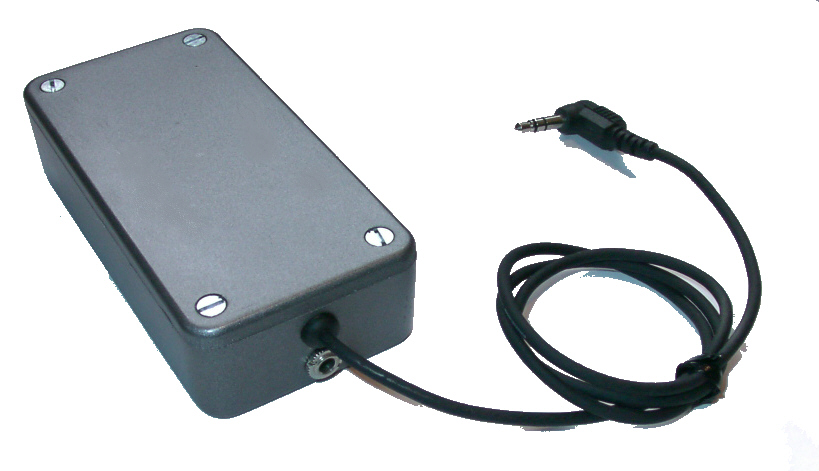
is a "battery module"?
A "battery
module" is another name for an in-line (in series) auxiliary power
source, or power supply. In most cases, the power for the battery
module is provided by a standard 9 volt D.C. (Direct current)
alkaline battery. The module also contains the necessary
electronic components to power an electret, or pair of electret
microphones (sometimes inaccurately called "condenser" microphones).
The module may also contain other components whose purpose is
to alter the bass response of the microphones plugged into it
(a "bass roll-off" filter), or controls that affect the output
level of the module (level controls). It is important to note
that a "battery module" WILL NOT increase the output of a microphone(s)
plugged into it-this is the job of a microphone preamplifier.
The battery modules purpose is to power a microphone, not amplify
it's signal level. Battery modules are known as "battery boxes"
by some manufacturers.
2-When
do I need to use a battery module?
When
you want to record very loud sounds
When
you want to record very loud sounds with a microphone/ recorder
combination, several things must be considered. All condenser
type microphones need a power source to operate. For the smaller
condensers (more correctly called "Electrets"), this power source
is generally 1.5 to 10 volts direct current (VDC). The closer
you get to providing 10vdc to the mics, the better they will be
able to handle loud sounds without producing any distortion. Many
of the MD, DAT, Camcorder and cassette recorders available today
provide a small power source at the mic input, often labeled "plug
in power". This power source is commonly about 3 to 4 vdc, but
can be lower in some Sony MD models (R70 and R90).
This
is enough voltage to power the mics, but not enough to let them
realize their full dynamic range. Because of this under-powering
at the mic input of the recorder, a battery module can be used
to replace the "plug in power" provided by the recorder. These
battery modules provide a little over 9 vdc, very close to the
optimum voltage for the microphones. Additionally, there is an
added benefit to using a battery module. When you use a battery
module, you are not dependent on the recorders "plug in power",
so in moderately loud to very loud situations, you
can use the line input of your recorder and still get acceptable
recording levels (in softer recording situations, you would still
need to use the mic input, even with the battery module).
The line
input has less noise than most microphone inputs as it bypasses
the relatively noisy mic pre amplification stage. The line input
is also capable of handling a much higher signal level than the
mic input, and will not result in a phenomena commonly know as
"brick walling", which happens when the signal fed into a mic
input is so high that it distorts the mic input, regardless of
the recording level setting.
When
the sound you are recording has excessive bass content
A
battery module equipped with a "bass roll off" filter (or bass reduction
filter) can be used to filter, or reduce varying degrees of bass
content from the sound to be recorded. This is especially important
when recording sounds with excessively high levels of bass content.
Our battery modules with this feature allow 7 choice of bass reduction,
from no reduction at all, to a high degree of reduction.
When
you want to avoid using the microphone input of your recorder
As
mentioned above, most built-in mic pre amps on the small portable
recorders are rather noisy and may add unwanted coloration to the
sound to be recorded. Using the line input will almost always result
in a less noisy, cleaner sounding recording. Using a battery module
in moderately loud to very loud situations, you can use the line
input of your recorder instead of the mic input. The line input
has less noise than most microphone inputs as it bypasses the relatively
noisy mic pre amplification stage. The line input is also capable
of handling a much higher signal level than the mic input, and will
not result in a phenomena commonly know as "brick walling", which
happens when the signal fed into a mic input is so high that it
distorts the mic input, regardless of the recording level setting.
When
you want to be able to adjust the recording level while recording
on a SONY MiniDisc
Many
of the current SONY MiniDisc recorders have a limitation built right
into them.....they don't allow the user to manually adjust recording
levels while you are recording. You must first pause the recording
before adjusting recording levels. This can be a nuisance if you
find the need to adjust the recording level in the middle of the
program you are recording. Because of this, we have an option available
on our full size and Slimline battery modules. This option allows
the user to adjust the output of the battery module, effectively
adjusting the recording level by changing the level of the signal
going into the recorder. These controls are mounted inside the battery
module to protect them from accidental movement while in a pocket
or bag, and to protect them from the elements for a longer, noise-free
life..
When
you want to use our mics with a recorder or other device that does
not supply "plug in power"
As
mentioned in #1 above, many recorders on the market today supply
"plug in power" at the mic input. However, there are some that don't....professional
recorders, very inexpensive recorders, mixers, etc. Even mixers
that have 48 volt phantom would need a battery module (or AT8533x
power adapter) to power the small electret mics as they are not
designed to work with 48VDC, and would be damaged if plugged directly
into 48VDC. Using a battery module will allow you to use the mics
with just about any piece of equipment that can accept a mic or
line level source.
When
you want to use our mics with a Camcorder in loud situations
Most
camcorders on the market today, while having "plug in power",
can't handle the high signal levels produced by microphones used
in loud situations. The signal level must be "attenuated", or
lowered, before it reaches the mic input of the recorder.
Our battery modules, when fitted with the level control option,
allow the user to reduce the output level of the mics so that
a camcorders mic input can handle the signal level without distorting
or "brick walling".
3-When
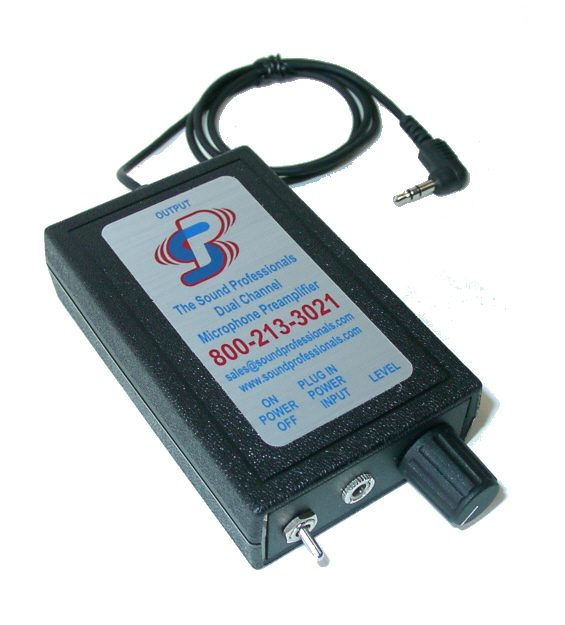
would it be better to use a mic preamp?
When
you own one of the newer SONY MD recorders
A
microphone preamp is useful when you have one of the newer SONY
MD recorders that DOES NOT have a microphone sensitivity
setting AND you want to be able to record sounds that are moderate.....not
loud enough for a battery module/line input combination (as
described above) but too loud for the easy-to-overload microphone
input of the MD recorder.
The Nomad® products are capable of making live recordings,
but only with a "pre-amplified" microphone (as stated
on their website). This is because the Nomad does not have a
built-in microphone preamp, as MD and DAT recorders do. So,
by combining a microphone with a preamp, you will be able to
feed a signal into the Nomad that is strong enough for high
quality recordings.
When
you want to use a microphone with a home recorder
Most home
recorders do not come with microphone inputs. Using a preamplifier
between your microphone and your home deck will allow you
to make live recordings with the home deck, plugging into
the analog line inputs.
Buy
a Battery Module...
Buy
a microphone preamp...
|